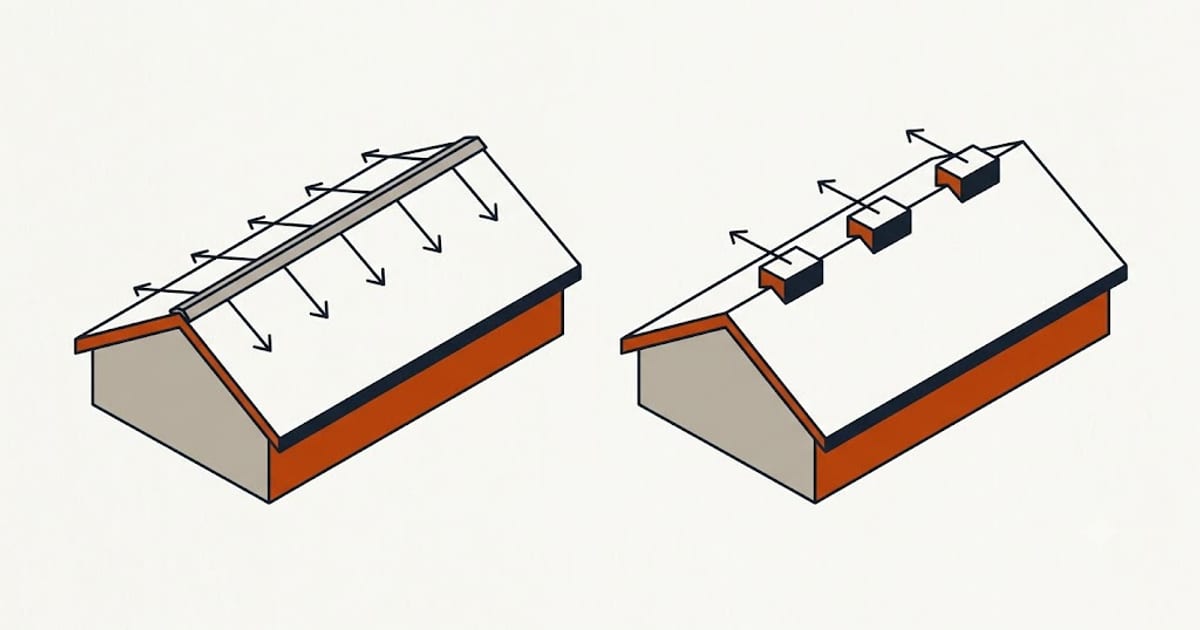
Both ridge vent and box vents exhaust an attic. They are rated in the same unit, they cost about the same per unit of that rating, and either one will pass inspection.
The difference that matters is what happens to the air in between them.
Net free area per unit
Exhaust is rated in square inches of net free area — actual open area after the baffle and the weather filter take their share.
| Product | Net free area | Unit |
|---|---|---|
| Shingle-over ridge vent | 12–18 in² | per linear foot |
| Aluminum ridge vent | 18 in² | per linear foot |
| Static box vent, 50 in² class | 50–60 in² | each |
| Turbine, 12 in | 100–150 in² | each |
| Gable louver, 12 × 18 | 55–70 in² | each |
A 40 ft ridge with an 18 in² per foot vent gives 720 in² of exhaust. Matching that with box vents takes twelve to fourteen of them, which is why nobody does it, and why a roof with four box vents is usually under-vented against the same roof with a ridge vent.
Work the requirement out first — the attic floor area and the 1/300 rule set the target, and the product choice comes after.
The distribution problem
This is the argument, and it is not about capacity.
A ridge vent exhausts along the entire ridge, so every rafter bay in the attic has an exhaust path directly above it. Air enters at the soffit below each bay, rises through that bay, and leaves at the top of the same bay.
Box vents exhaust at points. The bays near a box vent ventilate well. The bays between two box vents, and the bays at the far gable ends, ventilate by whatever cross-flow happens to reach them — which in an attic full of trusses, ducts and blown insulation is not much.
This is why a roof with adequate total net free area in box vents can still have a hot, damp corner, and it is almost always the corner furthest from a vent.
Why mixing them is worse than either alone
Air takes the shortest path between the intake and the nearest exhaust.
Put box vents low on a slope and a ridge vent above them, and the ridge vent — being higher and having the stronger stack effect — draws its makeup air down through the box vents rather than up from the soffits. The box vents reverse and become intakes. The soffits stop contributing. The bays that were relying on soffit intake now get nothing, and in a snow climate the box vents pull moist air and occasionally snow into the attic.
A powered gable fan mixed with a ridge vent does the same thing more aggressively: the fan pulls its air from the nearest few feet of ridge slot instead of from the far end of the attic, and the far end ventilates less than it did before the fan was installed.
Pick one exhaust type and remove the others. Sealing the old box vents during a re-roof takes ten minutes and is the single most common thing left undone.
Where box vents still win
A roof with almost no ridge. Hip roofs have short ridges — a hip with 8 ft of ridge cannot exhaust a 1,600 ft² attic no matter what product goes on it. Hip ridge vent exists and helps, but box vents or a combination are often the honest answer.
Multiple disconnected attic spaces. A house with three attics separated by knee walls needs exhaust in each one, and running ridge vent across all three ridges may not be possible.
Retrofit without a re-roof. Cutting in a ridge vent means opening the ridge and replacing the cap. Adding a box vent is one hole.
Cost
Shingle-over ridge vent runs roughly $9–14 per linear foot installed, so $400–600 on a typical 40 ft ridge, plus the ridge cap shingles that cover it — a line that gets forgotten and belongs with the rest of the accessory count.
Box vents run $60–120 each installed. Four of them is cheaper than a ridge vent and gives half the net free area and worse distribution, which is exactly why they are what a low bid contains.
The check that decides it
Look at the soffits before choosing anything. Exhaust is the half of ventilation that gets bought; intake is the half that gets blocked by insulation, and no exhaust product compensates for a starved attic. If the soffit is solid vinyl with decorative slots, that is the job — the ridge decision can wait.