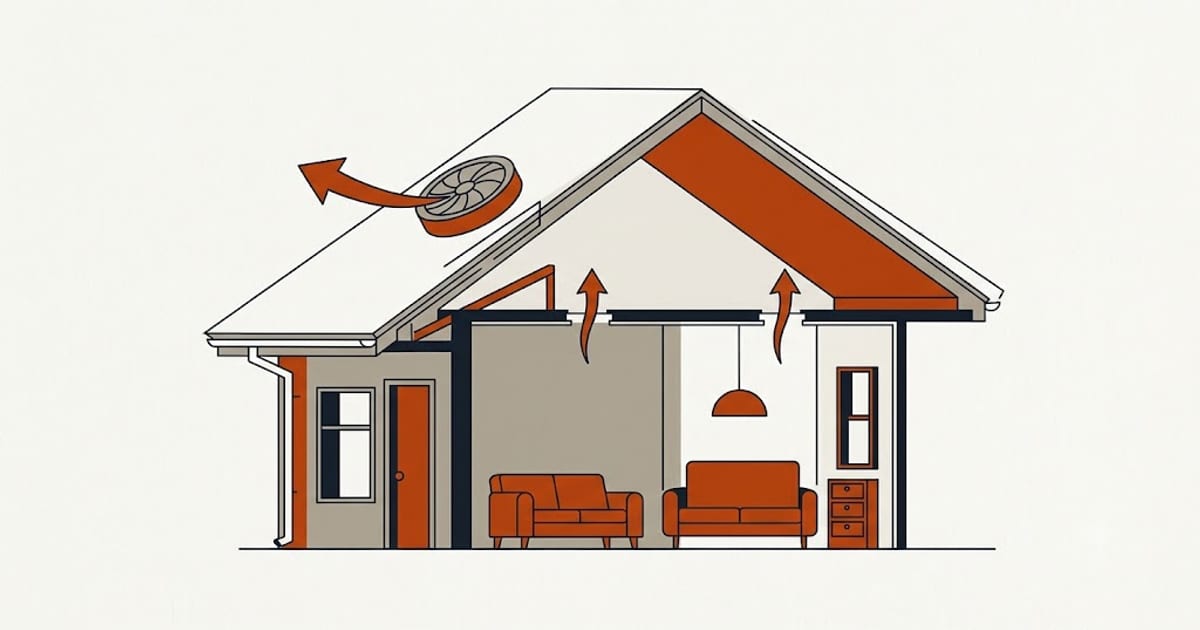
A powered attic ventilator moves hot air out of the attic with a fan instead of relying on the pressure difference between soffit and ridge. It is a common upsell on a re-roof, and it is one of the few roofing items where the honest answer is often do not buy it.
What they cost
| Type | Unit | Installed |
|---|---|---|
| Gable-mounted electric | $80–250 | $200–450 |
| Roof-mounted electric | $150–400 | $300–650 |
| Solar-powered roof mount | $350–800 | $600–1,200 |
| Thermostat / humidistat control | $25–60 | usually included |
Installed prices assume the wiring run is short and the deck is sound. Solar costs more up front and nothing to run, which is the whole of its argument — the fan itself is not better.
Ranges are typical US contractor pricing at the time of writing, not a quoted figure. Get three.
Why the fan may be working against you
This is the part the box does not say.
A powered fan pulls perhaps 1,000–1,600 CFM out of the attic. It has to get that air from somewhere. If the intake vents cannot supply it — and on most houses they cannot, because intake is the thing that is usually undersized — the fan takes the difference through the ceiling, from the conditioned space below.
That means:
- Air you have already paid to cool gets pulled into the attic and thrown outside
- The house goes slightly negative, so replacement air comes in through every gap in the envelope
- On a house with atmospherically-vented gas appliances, that negative pressure can backdraft a water heater
The Florida Solar Energy Center measured powered attic ventilators drawing conditioned air through ceiling leaks and concluded the cooling penalty could exceed the attic-temperature benefit. That result is why powered ventilators are treated with suspicion in current building-science practice.
What to do instead
Fix the passive path first, because it is cheaper and it cannot backdraft anything:
- Air-seal the ceiling plane — top plates, wire and pipe penetrations, the attic hatch. This is the single highest-value job in the attic.
- Add intake. Most attics are exhaust-heavy. See attic ventilation net free area for the 1/300 arithmetic and the balance rule.
- Then add insulation over a sealed ceiling.
A balanced soffit-to-ridge system moves air continuously, costs nothing to run, has no motor to fail and cannot depressurise the house.
When a fan does make sense
There are cases:
- A roof with no ridge and no usable soffit — a flat-to-low-slope addition, or a shallow hip where a ridge vent has nowhere to go
- A sealed, well-air-sealed ceiling where the intake has been verified adequate
- Attics converted to storage where humidity, not heat, is the problem
In those cases size the intake to the fan, not the other way round: 1 ft² of net free intake area per 300 CFM is the usual manufacturer requirement, and it is a lot more intake than most houses have.
The short version
The fan is $300–1,200. Air-sealing the ceiling and adding soffit vents is usually less, works all year rather than only when the thermostat calls, and does not risk pulling combustion gases back into the house. Spend there first.
Sizing one, if you are fitting one
The manufacturer rule of thumb is 0.7 CFM per square foot of attic floor, then a multiplier for roof colour:
| Attic floor | Base CFM | Dark roof (×1.15) |
|---|---|---|
| 1,000 ft² | 700 | 805 |
| 1,500 ft² | 1,050 | 1,208 |
| 2,000 ft² | 1,400 | 1,610 |
| 2,500 ft² | 1,750 | 2,013 |
Then the part that decides whether it helps or hurts: 1 ft² of net free intake area per 300 CFM.
A 2,000 ft² attic needs 1,610 CFM, which needs 5.4 ft² — 773 square inches — of net free intake. At around 65 in² of net free area per standard soffit vent, that is 12 soffit vents.
Most houses have four or five. That gap is not a detail; it is the whole reason the fan pulls air from the house instead of from outside. If the intake cannot be brought up to the number above, the fan should not go on.
Solar versus electric
Solar attic fans cost roughly twice the installed price of an electric one and move less air — typically 800–1,200 CFM against 1,200–1,600. What they buy is:
- No wiring run, which is most of the electric fan's labour cost on a finished house
- No running cost, and no meter reading that goes up in the month you fit it
- Operation that tracks sunshine, which is a rough proxy for when the attic is hot
What they do not buy is a solution to the intake problem. A solar fan on an attic with five soffit vents depressurises the house exactly as an electric one does; it simply does it for free.
Reading a quote
If a re-roof quote includes a powered attic ventilator, three questions decide whether it belongs there:
- How much net free intake area does this attic have now? If the roofer has not measured it, the fan is being sold rather than specified.
- Is there a ridge and a soffit? If both exist and are usable, a passive ridge vent does the same job with no motor.
- Are there atmospherically-vented gas appliances in the house? If yes, the depressurisation risk is not theoretical and the fan should be declined.