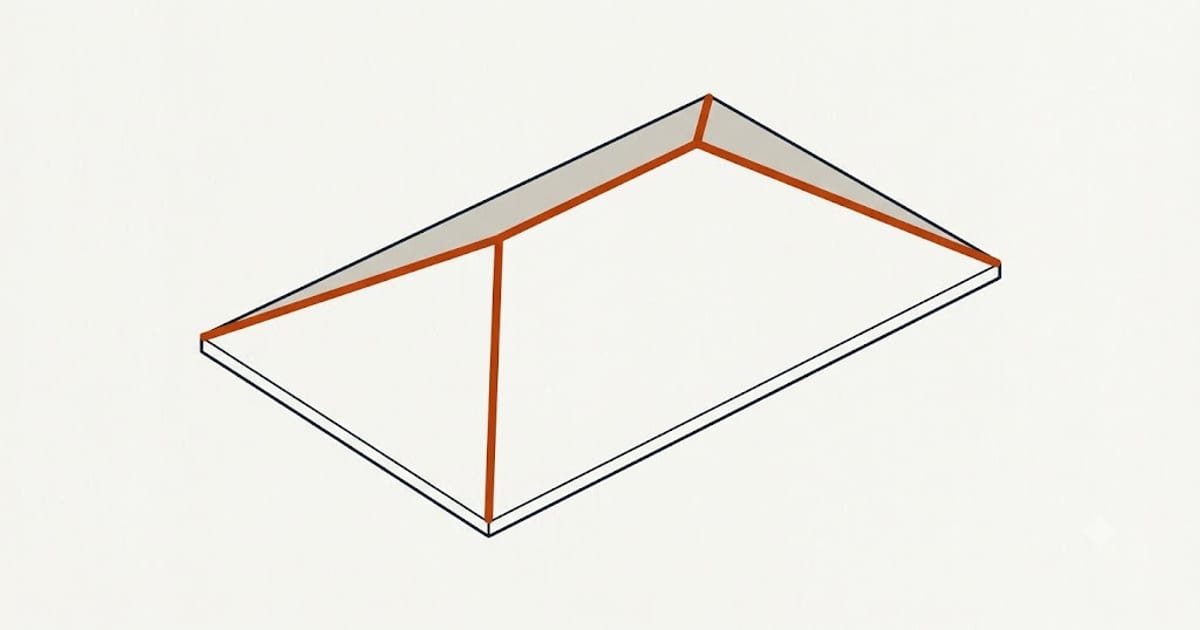
Ridge cap is the one roofing material sold in linear feet, not squares. Everything else on the roof scales with area; cap scales with the length of the lines where two planes meet.
That is also where the estimate goes wrong. People measure the ridge and stop.
Coverage per bundle
Two different products, two different numbers:
| Product | Exposure | Coverage per bundle |
|---|---|---|
| Manufactured hip & ridge (GAF Seal-A-Ridge, CertainTeed Shadow Ridge) | 8" | 20–25 linear ft |
| Manufactured high-profile (TimberTex, Shangle Ridge) | 8" | 20 linear ft |
| Three-tab cut into three caps | 5⅝" | ~33 linear ft per bundle of three-tab |
The coverage figure is printed on the wrapper and it is the only one that matters — the numbers above are the common range across the major manufacturers, not a standard. Check the bundle you are actually buying.
Cutting three-tab is cheaper per foot and looks it. The cut edge is square where a manufactured cap is contoured, and on an architectural roof the difference reads from the street. It is also not permitted with some architectural warranties.
The hips are the part people miss
A gable roof has one ridge. A hip roof has one ridge and four hips, and the hips are usually longer than the ridge.
Worked example — a 40 × 30 ft hip roof at 6/12 pitch:
- Ridge length: 40 − 30 = 10 ft
- Each hip runs from a corner to the ridge end. Horizontal run is 15 ft diagonally out and 15 ft along, so plan length is 15 × √2 = 21.2 ft; multiply by the 6/12 slope factor 1.118 → 23.7 ft each
- Four hips: 94.8 ft
- Total cap: 10 + 94.8 = 104.8 linear ft
The ridge is under a tenth of the job. Estimating from the ridge alone would have bought one bundle instead of five.
Adding waste
Cap gets cut at every start and finish, and the last cap on a run almost never lands whole. Add 10% — the same figure the rest of the roof uses.
104.8 ft + 10% = 115 ft → at 20 ft per bundle, 6 bundles.
Starter course at the ridge
On a ridge vent, cap goes over the vent and the exposure stays the same, but the vent adds its own length — a 40 ft ridge with a continuous vent still needs 40 ft of cap over it. The vent does not replace cap; it sits under it.
What to take away
- Cap is sold by the foot; read the coverage off the wrapper, do not assume 20
- Measure ridge and hips, and apply the pitch multiplier to the hips
- On most hip roofs the hips are 80–90% of the total
- 10% waste, same as the field
Nails: the length changes at the ridge
Cap nails are longer than field nails and the reason is stacking. At the ridge the fastener has to pass through the cap, the top course of shingles from both planes, the ridge vent if there is one, and still get ¾ inch of penetration into the deck — the figure the IRC uses for asphalt shingle fastening.
| Ridge build-up | Nail length |
|---|---|
| Cap over shingles, no vent | 1¾" |
| Cap over a low-profile ridge vent | 2" – 2½" |
| Cap over a high-profile vent or a second layer | 2½" – 3" |
Ridge vent manufacturers publish the required length for their product, and using the field nail is the most common installation error at the ridge. A 1¼ inch nail through a ridge vent reaches nothing; the cap lifts in the first strong wind and the failure looks like a wind claim rather than a fastening mistake.
Two nails per cap, placed so the next cap covers them. On the last cap the nails are exposed and get sealed with roofing cement — that is the one intentionally exposed fastener on the whole roof.
Gable versus hip, same footprint
The same 40 × 30 ft house, roofed two ways at 6/12:
| Ridge | Hips | Total cap | Bundles at 20 ft | |
|---|---|---|---|---|
| Gable | 40 ft | none | 44 ft with waste | 3 |
| Hip | 10 ft | 94.8 ft | 115 ft with waste | 6 |
Twice the cap for the same floor area, and it is a good check on a quote: a hip roof quoted with the cap allowance of a gable roof has been estimated off a plan view without the roof shape being looked at.
Ordering summary
- Measure the ridge from the plan — it needs no multiplier because it is level
- Measure each hip in plan, then apply the pitch multiplier
- Add the two, add 10%
- Divide by the coverage printed on the bundle
- Check the cap nail length against the ridge vent, not against the field