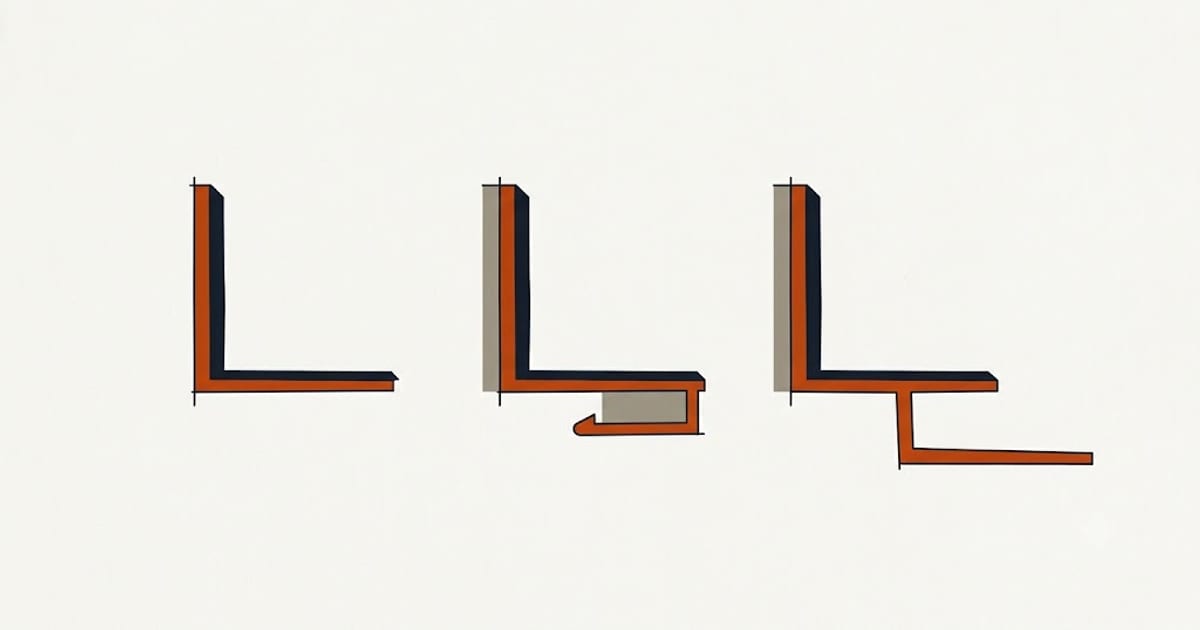
Drip edge is metal flashing that runs along the roof edge and pushes water off the deck instead of letting it run back under it. Since the 2012 IRC (R905.2.8.5) it is required at eaves and rakes on asphalt shingle roofs, not optional.
It is also the cheapest thing on the roof and the item most often missing from a quote.
Working out the length
Two numbers, added:
- Eaves — the horizontal bottom edges. Measure on the ground; the eave is level so there is no pitch multiplier.
- Rakes — the sloped gable edges. These do need the pitch multiplier, because you are measuring a slope from a plan.
Worked example — a 40 × 30 ft gable roof at 6/12:
- Eaves: two runs of 40 ft = 80 ft
- Rakes: horizontal half-span 15 ft × slope factor 1.118 = 16.8 ft, four rakes = 67 ft
- Total: 147 ft
Drip edge comes in 10 ft lengths and each joint overlaps 2–3 inches, so usable length is closer to 9 ft 9 in.
147 ÷ 9.75 = 15.1 → 16 pieces, and buy one spare. At the corners you cut and lap rather than mitre, which eats a few inches more.
Which type goes where
| Type | Profile | Where |
|---|---|---|
| Type C | Simple L | Older spec, still sold. Adequate at rakes. |
| Type D | L with a return lip at the bottom | Eaves and rakes. The lip kicks water clear of the fascia — this is the one to use. |
| Type F | Extended lower leg | Over an existing roof, or where you need reach over a gutter. Often called gutter apron. |
Type D is the default for new work. Type C sheds water onto the fascia board rather than past it, and rotten fascia is the usual result five years later.
The order it goes on
This is the part that gets reversed on site:
- At the eave, drip edge goes under the underlayment
- At the rake, drip edge goes over the underlayment
Reversed at the eave, water that gets under the shingles runs onto the fascia. Reversed at the rake, wind-driven rain gets behind the metal. The sequence is not aesthetic.
Cost
Galvanised steel drip edge runs roughly $2–4 per 10 ft length at trade counters; aluminium is similar, copper is many times that. On the 147 ft example above that is $35–65 in material for a code requirement that protects the deck edge and the fascia.
Labour is folded into the roof price rather than billed separately. If a quote itemises drip edge as an extra, that is a quote worth reading twice.
The failures you can see from the ground
Drip edge problems show up as three specific patterns, and all three are diagnosable without a ladder:
Stained or soft fascia under a sound roof. Water is running off the shingle edge and back onto the fascia instead of clearing it. Either there is no drip edge, or it is Type C where Type D was needed.
A dark line on the soffit near the wall. Water is tracking back along the underside. Usually the drip edge was fitted over the underlayment at the eave instead of under it, so anything that gets past the shingles lands on the wrong side of the metal.
Shingle edges curling down at the rake. Nothing to do with drip edge directly — but a rake with no metal behind the shingle edge has nothing to hold that edge flat, and wind gets under it. A rake drip edge is as much a wind detail as a water one.
Gutter apron is not the same thing
Type F, often sold as gutter apron, has a longer lower leg that reaches over the back of the gutter. It solves a different problem: on a house where the gutter sits slightly low or the fascia is out of plane, water can run off the drip edge and behind the gutter rather than into it.
If a house has a rotten fascia board behind a gutter that appears to work, gutter apron is usually the fix, and it can be slipped in without removing shingles. That makes it one of the few roof repairs that is genuinely a small job.
Sequence on a re-roof
Order matters and it is easy to get wrong when the deck is already stripped:
- Eave drip edge onto the bare deck
- Ice barrier over it, lapping onto the metal
- Field underlayment
- Rake drip edge on top of the underlayment
- Starter course, then shingles
Step 4 out of order is the common one, because it is natural to fit all the metal at the same time. If the rake metal goes down before the underlayment, the underlayment has to be trimmed short of the edge and the rake loses its water barrier.