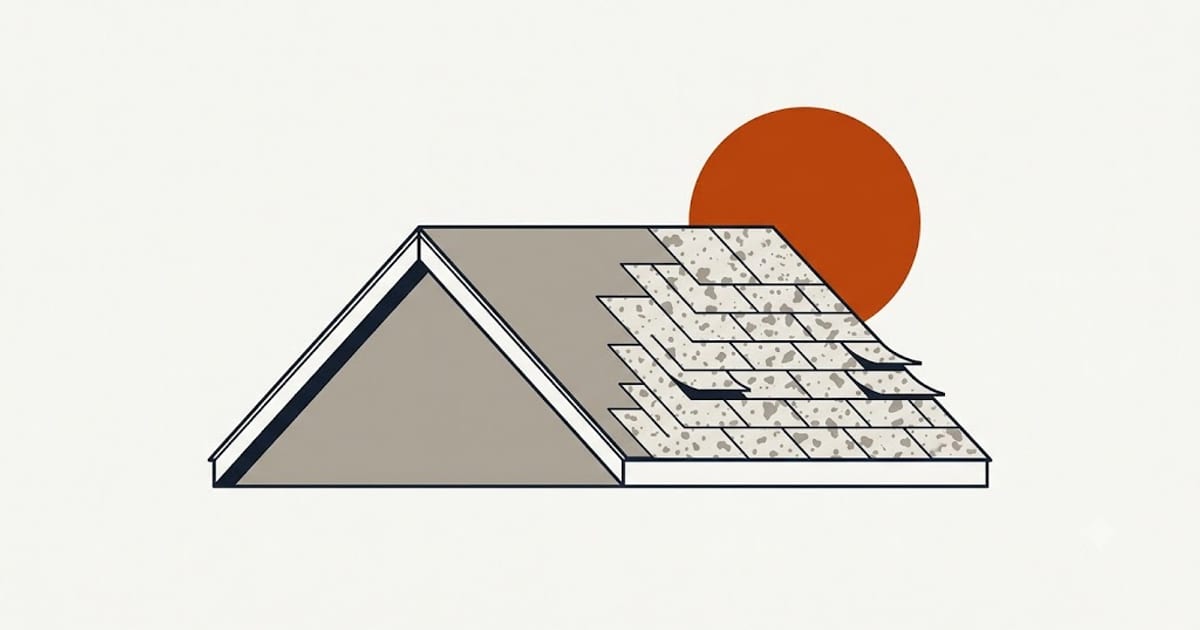
Asphalt shingles are sold with a number on the wrapper — 25 year, 30 year, lifetime — and that number describes a product tested in a laboratory, not a roof on a house in your climate.
The gap between the two is large, predictable, and almost entirely down to things decided before the first bundle went up.
What the classes actually last
| Shingle | Wrapper says | Typical real service |
|---|---|---|
| 3-tab, 20-year | 20–25 yr | 12–18 yr |
| 3-tab, 25-year | 25 yr | 15–20 yr |
| Architectural, 30-year | 30 yr | 20–27 yr |
| Architectural, "lifetime" | 50 yr / limited | 25–32 yr |
| Premium / designer laminate | 50 yr / limited | 30–40 yr |
Two things stand out. Every class comes in short, and the shortfall widens as the rating goes up — because "lifetime" is a warranty term of art rather than a service prediction, and the prorated portion of it is worth very little after year ten.
The four things that decide where in the range you land
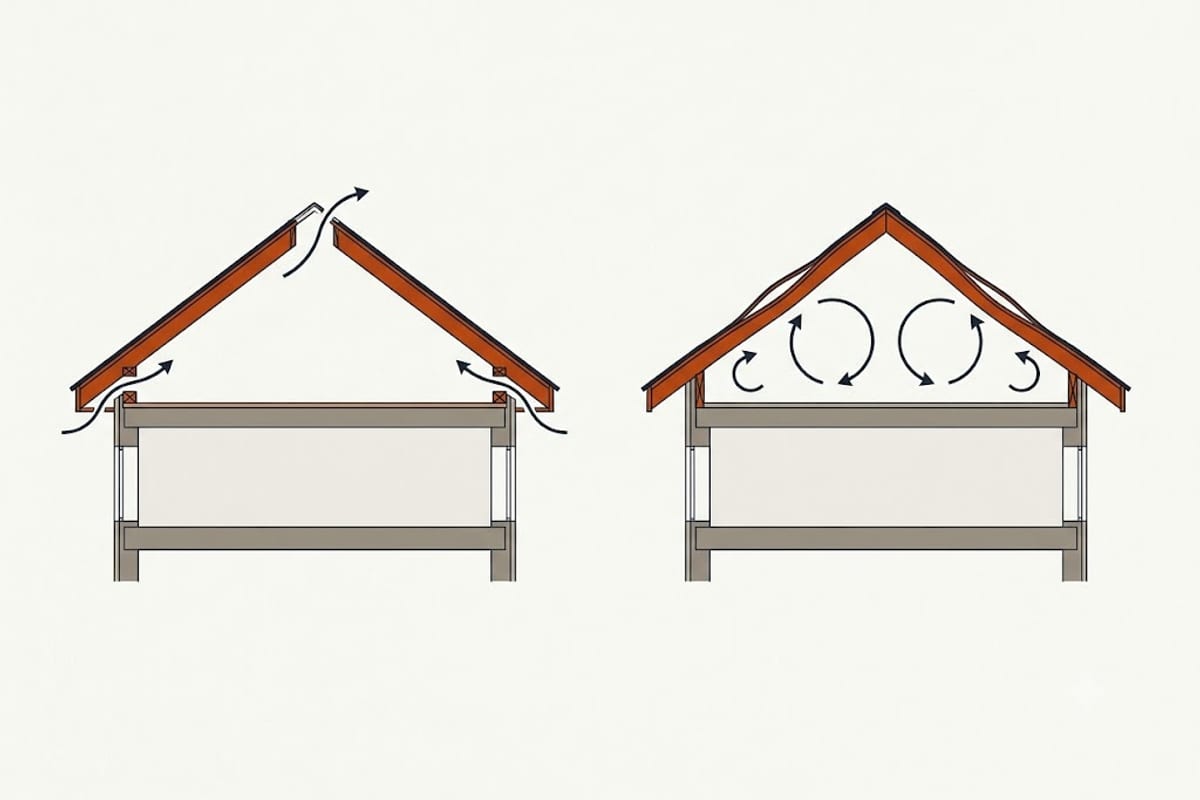
Ventilation. This is the largest single factor and the one most often missing. An attic that cannot exhaust heat runs a deck surface temperature 30–50 °F above an attic that can. Asphalt ages by losing volatiles, and that process roughly doubles in rate for every 18 °F. A poorly ventilated roof can lose a third of its life without a single defect in the shingle.
Slope orientation. The south and west slopes of a roof receive substantially more UV and more thermal cycling than the north slope. On most failed roofs the south slope is visibly further gone, and it is normal for one slope to be granule-bare while another looks serviceable.
Number of layers. A roof laid over an existing layer traps heat between them and cannot dissipate it downward. Expect to lose 20–25% of service life, and expect the tear-off when it finally comes to cost double.
Climate. Hail is the fastest way to end a roof regardless of rating. Freeze-thaw cycling comes second. A shingle in a mild coastal climate outlives the same shingle in the upper Midwest by years.
What failure looks like before it leaks
Granule loss first — the granules are the UV shield, and once they are gone the asphalt below is on a clock measured in months rather than years. Look in the gutters, not on the roof.
Then curling and clawing at the tab edges as the mat shrinks. Then cracking across the tabs. Leaks come last, and by the time water is in the house the roof has been failing for two or three years.
A roof that has lost enough granules to expose the mat is not a repair candidate, whatever the age on paper.
Price per year, not per square
This is the number that makes the decision, and almost nobody computes it.
A 30-square roof in 3-tab at $4.50 per square foot is $13,500 for 16 years — $844 a year. The same roof in architectural at $5.75 is $17,250 for 24 years — $719 a year. The more expensive roof is the cheaper roof, by 15%, and it also looks better.
Premium laminate at $8.00 is $24,000 over 34 years, or $706 a year — effectively a tie with architectural, so the choice between those two is about appearance and wind rating rather than money.
3-tab wins on one scenario only: a house being sold inside five years, where the up-front number is the only number that matters.
Work it out for your own roof size with the per-square cost figures, and remember that tear-off is a separate line that arrives once per roof life, not once per year.
The cheapest thing you can do for roof life
Fix the ventilation while the roof is off. Adding soffit intake and a continuous ridge vent during a re-roof costs a few hundred dollars and is the difference between the 20-year and the 27-year end of the architectural range.
Doing it later means going back onto a finished roof and cutting it open, which nobody wants to pay for and so nobody does.