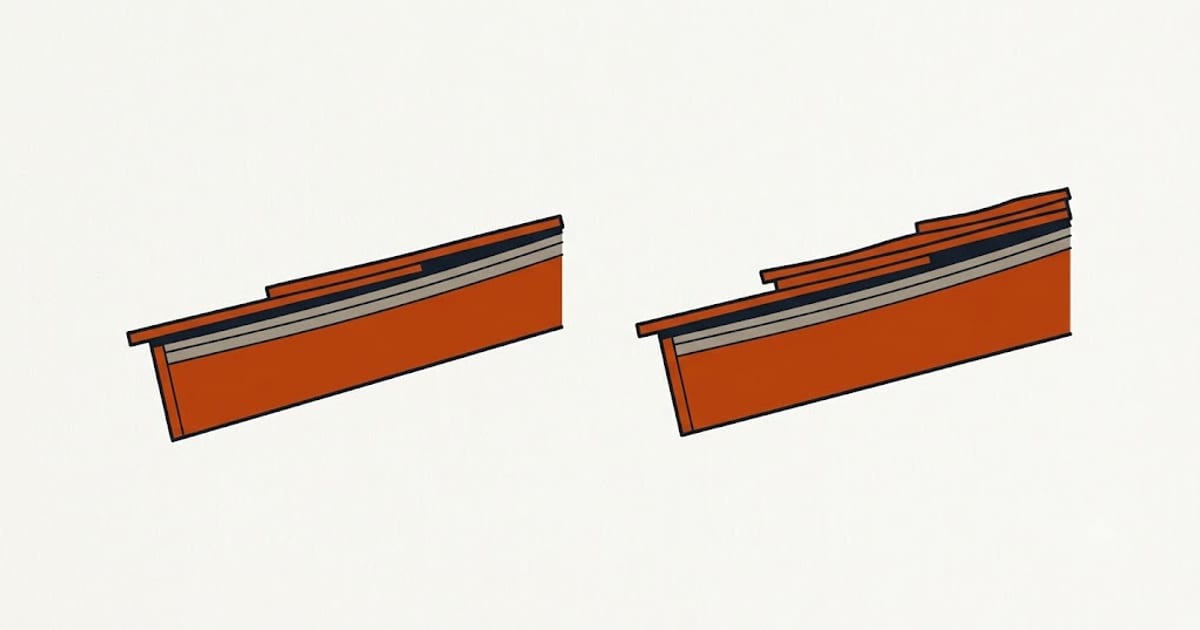
Most US jurisdictions allow two layers of asphalt shingle and no more. A third is a code violation almost everywhere, and the reason is weight: each layer is 200–350 lb per square, and a third puts a typical roof structure past what it was framed for.
So the question is only ever about the second layer, and it is a genuine trade-off rather than an obvious mistake.
What you save
Tear-off and disposal run $75–$150 per square, on top of the installation labor itself. On a 20-square roof that is $1,500 to $3,000, and it is the single largest saving available on a roofing job.
You also save a day, and a day is a night the roof is not under tarps.
What you give up
Shingle life. The new layer sits on the old one, which holds heat. Asphalt ages by heat more than by anything else. Expect to lose roughly 20–25% of the service life — a 25-year shingle behaving like a 19-year one.
The deck inspection. This is the real cost. With the old shingles off, the entire roof deck is visible: soft spots, delaminated sheathing, rot at the eaves, nail pops, the flashing detail around the chimney that has been leaking slowly for six years. Roofing over covers all of it, and covers it for the next fifteen years.
Water damage that could have been a $200 sheet of plywood becomes a framing repair.
Flashing. Done properly, roofing over still means new step flashing at walls and new counter-flashing at the chimney. Done cheaply, the new shingles are lapped over the old flashing — and that is where the roof will leak.
Warranty. Many manufacturers reduce or void the material warranty on a second-layer installation. Read the specific product's installation instructions; it is stated plainly and it varies by brand.
The next tear-off. Two layers cost roughly double to remove. You are deferring the tear-off cost and adding to it, not avoiding it.
The lumpy surface problem
New shingles telegraph the old ones. Every ridge, every curled tab, every cupped course shows through the new layer, and it is visible from the street on a sunlit afternoon.
Some of it can be managed — badly curled shingles get removed, ridge cap comes off, a "recover board" or bridging course flattens the worst of it. All of that is labor, and it eats into the saving that motivated the decision.
When roofing over is actually reasonable
- The existing layer is flat, single, and dry — the roof is being replaced for age, not for a leak
- The deck condition is known from the inside, and the attic is dry with no staining
- The roof is a simple gable with minimal flashing
- You are selling within a few years and disclosing the two layers
- The pitch is 4/12 or steeper, so water is moving fast
When it is not
- Any current or historic leak — which is a repair question first
- Curled, cupped or missing shingles
- Any sag visible along the ridge or between rafters
- Two layers already — this is the end of the road
- You intend to keep the house for fifteen years or more
- The roof has valleys, dormers or a chimney that need flashing done right
The arithmetic over 25 years
Tear off now: full cost, full shingle life, deck condition known.
Roof over now: save $1,500–$3,000, lose about five years of shingle life, then pay double tear-off. Over one full cycle the saving is usually gone, and the risk of an unseen deck problem was carried the whole time.
Which is why the honest answer is: roofing over is a cash-flow decision, not a value decision. If the money is genuinely not there this year and the roof is dry, it is a defensible choice. If it is there, tear off.
Either way the square count is the same, and it is the number both quotes should agree on — work it out from your size and pitch before either contractor arrives.