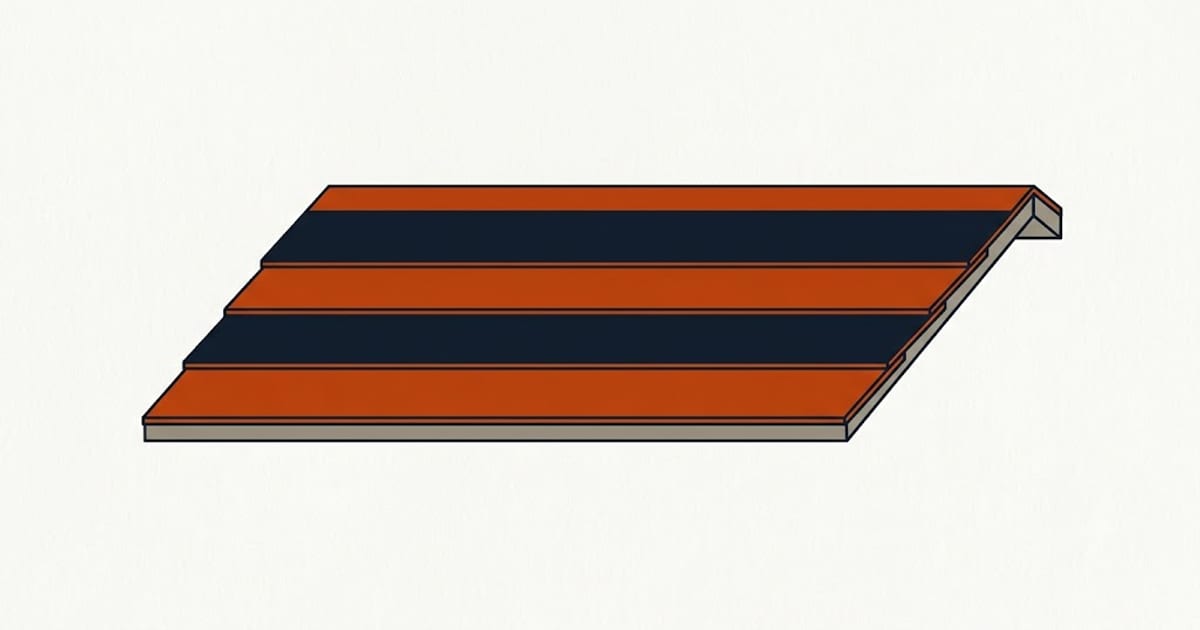
Underlayment is sold by the roll, and the number on the label is the material in the roll, not the roof it covers. The lap takes the difference.
Roll coverage before and after lap
| Product | Roll size | Label coverage | Real coverage at 2″ lap |
|---|---|---|---|
| #15 felt | 36″ × 144 ft | 4 squares | ~3.7 squares |
| #30 felt | 36″ × 72 ft | 2 squares | ~1.85 squares |
| Synthetic | 48″ × 250 ft | 10 squares | ~9.4 squares |
| Synthetic | 42″ × 286 ft | 10 squares | ~9.4 squares |
Synthetic loses proportionally less because the roll is wider — a 2-inch lap on a 48-inch sheet costs 4% of the material; the same lap on a 36-inch sheet costs 5.6%.
Add 10% on top of the lap allowance for the ends of courses, cuts around penetrations and the piece that never quite reaches.
The pitch condition that doubles it
Under the IRC, roofs from 2/12 to under 4/12 require two layers, lapped 19 inches rather than 2. That is not "two rolls side by side" — it is full 36-inch courses each covering 19 inches of the one below, which produces two layers everywhere.
The material requirement roughly doubles. On a 20-square shallow roof that is the difference between 6 rolls of synthetic and 11.
At 4/12 and above, one layer with a 2-inch lap is all the code asks for.
Which band your roof is in is worth settling before ordering, because the two answers differ by half the material.
Worked example
18-square roof, 6/12 pitch, using 48″ × 250 ft synthetic:
- 18 squares ÷ 9.4 real squares per roll = 1.9 rolls
- +10% for cuts and course ends = 2.1
- Order 3 rolls — nobody sells two-thirds of a roll, and the spare is the cheapest insurance on the job
The same roof at 3/12 pitch: 18 ÷ 4.7 (double layer) = 3.8 → order 5 rolls.
Felt or synthetic
| #15 / #30 felt | Synthetic | |
|---|---|---|
| Cost per square | Lower | 1.5–2.5× higher |
| Weight | Heavy, tears wet | Light, tough |
| Exposure rating | Days | Weeks to months |
| Walkability | Slippery when damp | Textured, better grip |
| Wrinkling | Yes, when it gets wet | No |
The wrinkling matters more than it sounds. Felt that gets rained on before the shingles go down wrinkles, and the wrinkles telegraph through the finished roof as visible ridges. On a job that will be dried in the same day it is a non-issue; on a job that takes three days in changeable weather it is the whole argument for synthetic.
Synthetic also weighs a fraction of felt, which is one fewer reason for a crew to cut a course short.
Ice barrier is a separate product and a separate line
Self-adhering ice-and-water membrane is not underlayment and does not substitute for it. Where code requires it — from the eave to 24 inches inside the exterior wall line, in climates with an ice dam history — it goes down first, and the field underlayment laps over its upper edge.
It is also worth using at valleys, around chimneys and skylights, and along rake edges on exposed sites, whether or not code requires it there. Those are the places roofs actually leak.
Fastening
Cap nails or cap staples, not smooth roofing nails. A plain nail head pulls through the sheet in wind, and a synthetic roll left to flap for one gusty night is a roll to be replaced.
Around six to eight fasteners per square yard is typical; more on exposed sites and more if the deck will be open overnight.
Order it against the same square count as the shingles
Underlayment covers the same area as the field shingles, so the square count from footprint, pitch factor and waste is the number to use — with the waste factor left in, because underlayment is cut around the same obstacles the shingles are.