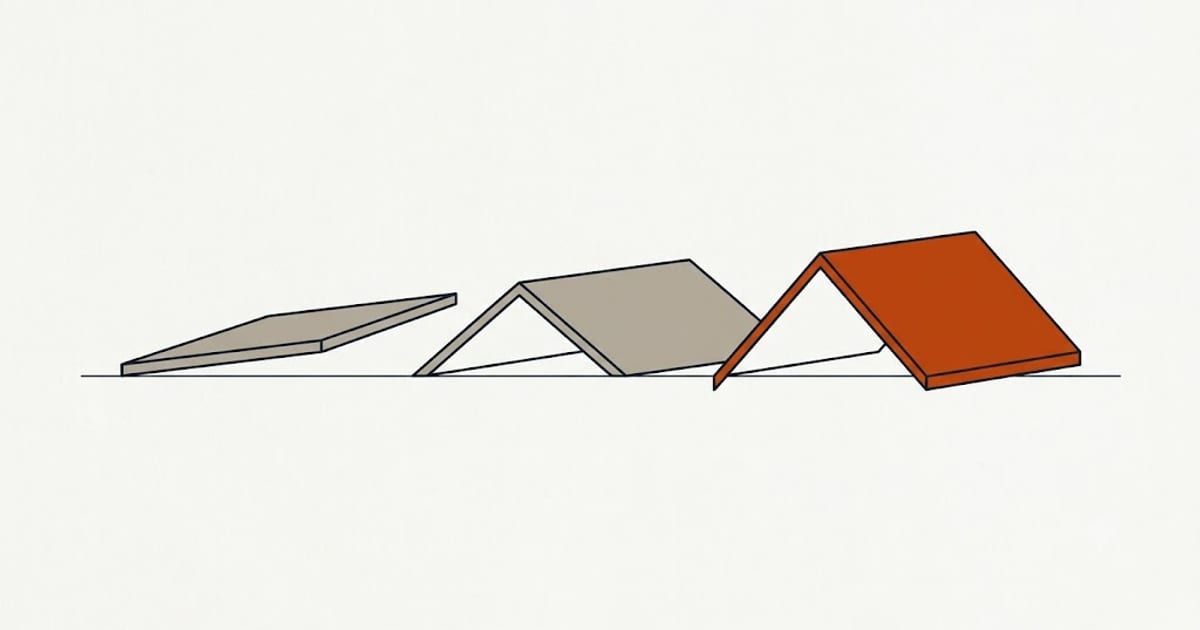
2/12 is the minimum pitch for asphalt shingles under the IRC (R905.2.2), and every manufacturer's installation instruction agrees.
Below that, shingles are not permitted at any price. Water moves too slowly across the surface and wind drives it back up under the courses, and no amount of sealant changes that.
The three bands
| Pitch | Asphalt shingles | Underlayment required |
|---|---|---|
| Below 2/12 | Not permitted | Low-slope membrane instead |
| 2/12 to under 4/12 | Permitted | Two layers, lapped 19″ |
| 4/12 and above | Permitted | One layer, lapped 2″ |
The middle row is the one that gets skipped. Doubled underlayment on a 2/12 to 4/12 roof is not a suggestion — it is code, it is in the manufacturer's instructions, and installing without it voids the material warranty.
It is also the single most common shortcut on shallow roofs, because it is invisible the moment the shingles go down.
What "two layers, lapped 19 inches" means in practice
Start with a 19-inch strip along the eave. Then run full 36-inch courses up the roof, each lapping the one below by 19 inches. The result is two layers of felt or synthetic everywhere.
It uses roughly twice the underlayment of a standard roof, and that is the real reason it gets skipped: it is a visible line on a quote that a competing quote might not have.
If two roofing quotes on a 3/12 roof differ by around the cost of a few rolls of underlayment, that is likely what the difference is. Ask.
Below 2/12 you are buying a different roof
A roof under 2/12 needs a low-slope membrane — modified bitumen, TPO or EPDM. That is a different trade, different detailing and a different price per square, typically higher than asphalt.
It is worth knowing before you get quotes, because a roofer who quotes shingles on a 1.5/12 porch either has not measured the pitch or is planning to install something that will not pass inspection and will not last.
Porches are where this bites. A house at 7/12 with a porch roof at 1.5/12 needs two systems, and the transition between them needs detailing. That is normal work; it just needs to be in the quote.
Ice barrier changes with pitch too
In climates with a history of ice damming, the IRC requires a self-adhering ice-and-water membrane from the eave to a point 24 inches inside the exterior wall line, measured along the slope.
On a shallow roof that horizontal 24 inches translates into more material than on a steep one, because the slope distance to reach the same horizontal point is shorter — but the eave overhang has to be covered too. On deep overhangs it commonly means two courses of membrane rather than one.
Wind ratings are pitch-sensitive as well
Manufacturers rate shingles for wind resistance at standard installation. On low slopes some products require six nails instead of four and hand-sealing of the tabs. Read the installation instruction for the specific product; the requirement is stated there and nowhere else.
Checking your own pitch first
None of this can be decided from a photograph of the house. Measuring pitch from the attic or a gable photo takes ten minutes and settles which band each roof plane is in.
And once you know the pitch, the multiplier turns footprint into actual roof area — on a shallow roof that multiplier is nearly 1, which is the one small mercy of a low-slope roof.
What a low-slope roof costs instead
Below 2/12 the choices are membrane systems, and they price differently from shingles:
| System | Installed per square | Life |
|---|---|---|
| Modified bitumen | $500–$900 | 15–20 yr |
| TPO single-ply | $600–$1,000 | 20–30 yr |
| EPDM rubber | $550–$950 | 20–30 yr |
| Built-up, tar and gravel | $600–$1,100 | 20–30 yr |
More per square than asphalt, and on a small porch roof the mobilisation cost dominates — a roofer bringing a different crew and different equipment for three squares prices it accordingly.
Which is the argument for doing the porch and the main roof at the same time, with one contractor, rather than discovering the problem two years later.
The tell that a roof was shingled too shallow
Water staining at the top of the wall below a porch roof, in a house whose main roof looks fine. On a shallow slope wind pushes water back up under the courses, and it emerges at the wall junction rather than in the middle of a ceiling.
If a porch ceiling is stained and the main roof is dry, measure the porch pitch before anything else. A shingled 1/12 porch cannot be repaired into working; it has to be re-covered with the right system.
Manufacturers publish their own minimums, and some are higher
The IRC sets the floor at 2/12. Individual products set their own, and several premium and designer shingles specify 3/12 or 4/12 regardless of what code allows.
The installation instruction in the bundle is the governing document for the warranty. Code tells you what is legal; the instruction tells you what is covered, and those are not the same test.