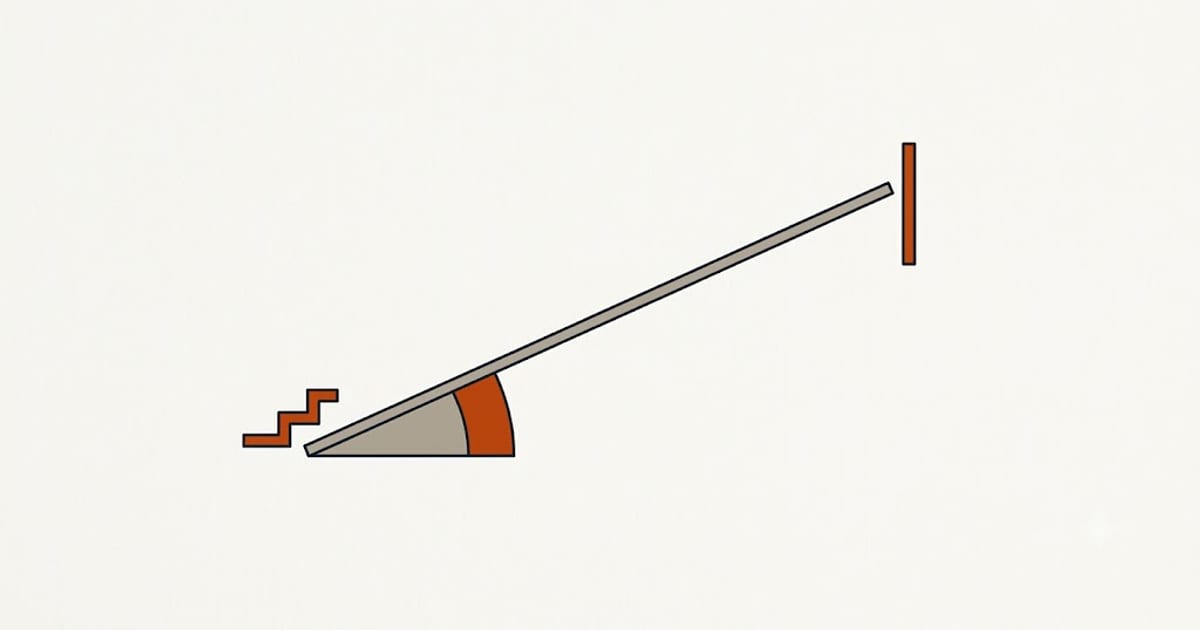
Three units describe the same thing and none of them convert in your head:
degrees = arctan(rise ÷ 12) percent = (rise ÷ 12) × 100
A 6/12 roof is 26.57° and 50%. Not 6° and not 6%.
The table
| Pitch | Degrees | Percent |
|---|---|---|
| 1/12 | 4.76° | 8.3% |
| 2/12 | 9.46° | 16.7% |
| 3/12 | 14.04° | 25.0% |
| 4/12 | 18.43° | 33.3% |
| 5/12 | 22.62° | 41.7% |
| 6/12 | 26.57° | 50.0% |
| 7/12 | 30.26° | 58.3% |
| 8/12 | 33.69° | 66.7% |
| 9/12 | 36.87° | 75.0% |
| 10/12 | 39.81° | 83.3% |
| 11/12 | 42.51° | 91.7% |
| 12/12 | 45.00° | 100.0% |
| 15/12 | 51.34° | 125.0% |
| 18/12 | 56.31° | 150.0% |
| 24/12 | 63.43° | 200.0% |
Two things worth noticing. 12/12 is 45°, not 90° — a common misreading, because 12/12 "sounds like" the maximum. And percent can exceed 100, because it is a ratio of rise to run rather than a share of anything.
Which unit gets used where
Pitch (x/12) is the US roofing convention. Every shingle installation instruction, every IRC table, every framing square is in x/12. If you are ordering material or cutting rafters, work in pitch.
Degrees is what miter saws, digital angle finders and phone inclinometer apps report. It is also what solar installers use, because panel tilt is specified in degrees.
Percent grade is a civil engineering and roads convention that turns up in commercial roofing specifications and in some European documentation. It is the least common of the three in residential work and the one most likely to be misread.
Where the confusion causes damage
Cutting rafters from an angle finder reading. The saw wants the complement for a plumb cut at the ridge, and the birdsmouth seat cut is the other angle. Reading 26.57° off an app and setting the saw to 26.57° for both cuts produces a rafter that fits neither end.
Solar quotes. Panel tilt is quoted in degrees, roof pitch in x/12. A "30° tilt" on a "7/12 roof" is nearly flush mounting, because 7/12 is 30.26°. On a 4/12 roof the same panel needs a 12° rack. Getting these mixed up changes the racking cost.
Snow load and ice. Codes and manufacturer guidance often quote thresholds in degrees while your roof is measured in pitch. Convert once, write it down.
Getting the angle without a calculator
Hold a digital level or a phone inclinometer flat against the roof plane, or against a rafter in the attic. That reads degrees directly.
To get pitch from it: rise = tan(degrees) × 12. A 22° reading gives 0.404 × 12 = 4.8, so a roof that is between 4/12 and 5/12 — and roofs are rarely exact, so round to the nearest common pitch and check against a framing square.
If you would rather not convert at all, measuring pitch directly with a level and a tape gives x/12 in the first place.
The unit that actually orders material
None of these three. The area factor — √(1 + (rise ÷ 12)²) — is what turns footprint into roof surface, and it is a fourth number derived from the same slope. The full multiplier chart sits alongside the angle table above, and it is the one that decides how many bundles arrive on the truck.
Cutting rafters from pitch, not from the angle
A framing square works in x/12 directly and needs no conversion. Set the square with the rise on the tongue and 12 on the blade: the blade edge marks the plumb cut at the ridge, the tongue marks the seat cut of the birdsmouth.
From a miter saw the arithmetic is different, and this is where the two units collide:
- Plumb cut, against the ridge board: set the saw to 90° − pitch angle. A 6/12 roof at 26.57° means a 63.43° cut, past the range of most miter saws — which is why plumb cuts are usually marked with a square and cut with a circular saw.
- Seat cut, the horizontal face of the birdsmouth: set the saw to the pitch angle itself, 26.57°.
Setting both to the same number is the most common rafter mistake, and it produces a rafter that rocks at the ridge and gaps at the plate.
Two pitches meeting is a third angle
Where two roof planes of different pitch meet, the valley angle is neither of them and it is not the average either. An unequal-pitch valley resolves into a compound cut, and the practical route is to lay the first board in, scribe it against both planes and cut to the scribe.
This is the one place on a roof where measuring beats calculating, and it is worth knowing before ordering long valley stock.
What the angle is actually good for
Solar. Panel output depends on tilt from horizontal, quoted in degrees. A roof already sitting near the latitude-matched tilt needs no rack at all, which is the cheapest solar mounting there is.
Snow. Snow sheds reliably above about 40°, roughly 10/12, and holds on below about 20°, roughly 4/12. Between the two it does both at unpredictable moments — the range where snow guards over a doorway earn their price.
Walkability. Above about 34°, which is 8/12, most people cannot stand on a roof unaided. That single threshold moves a roofing quote more than any material decision does.