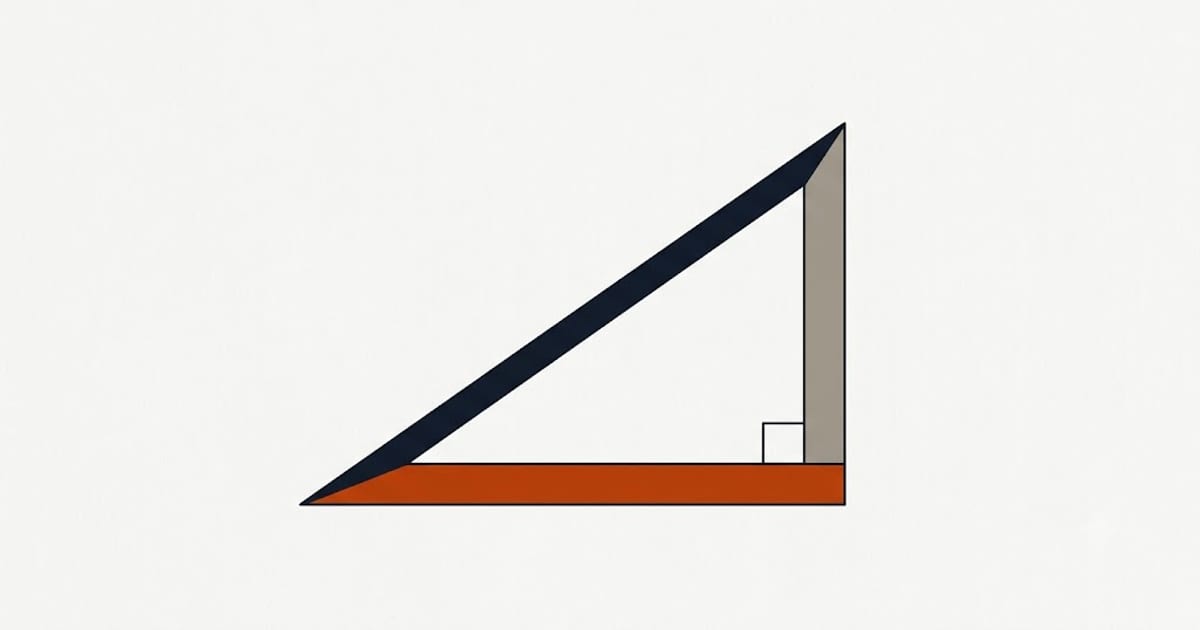
The pitch multiplier converts horizontal area into sloped area. It comes straight out of Pythagoras and there is no estimating in it:
multiplier = √(1 + (rise ÷ 12)²)
A 6/12 roof: √(1 + 0.25) = 1.118. Every square foot of ground under that roof is 1.118 square feet of roof surface.
The chart
| Pitch | Multiplier | Angle |
|---|---|---|
| 1/12 | 1.0035 | 4.8° |
| 2/12 | 1.0138 | 9.5° |
| 3/12 | 1.0308 | 14.0° |
| 4/12 | 1.0541 | 18.4° |
| 5/12 | 1.0833 | 22.6° |
| 6/12 | 1.1180 | 26.6° |
| 7/12 | 1.1577 | 30.3° |
| 8/12 | 1.2019 | 33.7° |
| 9/12 | 1.2500 | 36.9° |
| 10/12 | 1.3017 | 39.8° |
| 11/12 | 1.3566 | 42.5° |
| 12/12 | 1.4142 | 45.0° |
| 14/12 | 1.5366 | 49.4° |
| 16/12 | 1.6667 | 53.1° |
| 18/12 | 1.8028 | 56.3° |
Note how fast it climbs past 8/12. A 12/12 roof has 41% more surface than the ground it covers. On a 1,500 ft² footprint that is 615 extra square feet — over six squares of shingle that a footprint-based estimate never sees.
Where it gets applied wrongly
On the wrong area. The multiplier applies to the footprint including overhangs, measured horizontally. Not to the floor area of the rooms below, which excludes wall thickness, garages and porches.
Twice. If you measured the actual rafter length on site, you already have the sloped dimension. Multiplying that by the pitch factor again over-orders by 12–40%. The multiplier converts horizontal to sloped, once.
To gable ends. Gable end walls are vertical triangles, not roof. They are siding, not shingle, and they do not take the multiplier.
With mixed pitches. A house with a 9/12 main roof and a 4/12 porch needs two calculations. Applying the main roof's multiplier to the whole footprint over-orders on the porch — harmless for cost, but it means the waste allowance is no longer what you think it is.
Worked example
A 36 × 28 ft house with 18-inch overhangs on all sides, 7/12 pitch, hip roof:
- Footprint with overhangs: 39 × 31 = 1,209 ft²
- × 1.1577 = 1,400 ft² of roof
- × 1.15 hip waste = 1,610 ft²
- 16.1 squares → order 17
Without the multiplier the same estimate reads 1,209 × 1.15 = 13.9 squares. Three squares short, which is roughly a fifth of the job.
What else the multiplier tells you
It is also the rafter length ratio. A rafter spanning 14 ft of run at 7/12 is 14 × 1.1577 = 16.2 ft long before the ridge and birdsmouth cuts. Rafter lengths by pitch and span are worked out for every combination.
And the ridge height above the wall plate is the half-span × rise ÷ 12 — the other measurement people need constantly and rarely calculate.
Where it stops being enough
The multiplier gives area. It does not give waste, and waste is a property of roof shape rather than pitch: 10% on a simple gable, 15% on a hip, 20% on anything with valleys and dormers.
The complete path from tape measure to bundle count puts both together.
Hips and valleys use a different multiplier
The pitch multiplier gives the length of a common rafter — one running straight up the slope. A hip or valley rafter runs diagonally across the corner and is longer again, because it climbs the same rise over a longer horizontal run.
hip / valley multiplier = √(2 + (rise ÷ 12)²)
| Pitch | Common rafter | Hip / valley rafter |
|---|---|---|
| 4/12 | 1.054 | 1.452 |
| 6/12 | 1.118 | 1.500 |
| 8/12 | 1.202 | 1.563 |
| 10/12 | 1.302 | 1.642 |
| 12/12 | 1.414 | 1.732 |
The 2 under the root instead of a 1 is the diagonal of the square in plan. It is why a hip rafter on a 6/12 roof is half again as long as its run, while the common rafter is only 12% longer.
Ordering hip stock by the common rafter multiplier is the classic way to end up with a pile of timber that is all six inches short.
The multiplier does not scale every material
Shingles, underlayment and ice barrier scale with roof area, so they take the multiplier directly.
Ridge cap, drip edge, starter strip and gutter scale with linear feet of edge, and those edges are horizontal or nearly so. Applying the area multiplier to them over-orders every time.
Rafters and hips scale with length, which uses the multipliers above rather than the area factor — the same square root applied to a line instead of a plane.
Three different behaviours out of one roof shape, which is why a single "add 20% for pitch" rule of thumb misprices at least two of the three.