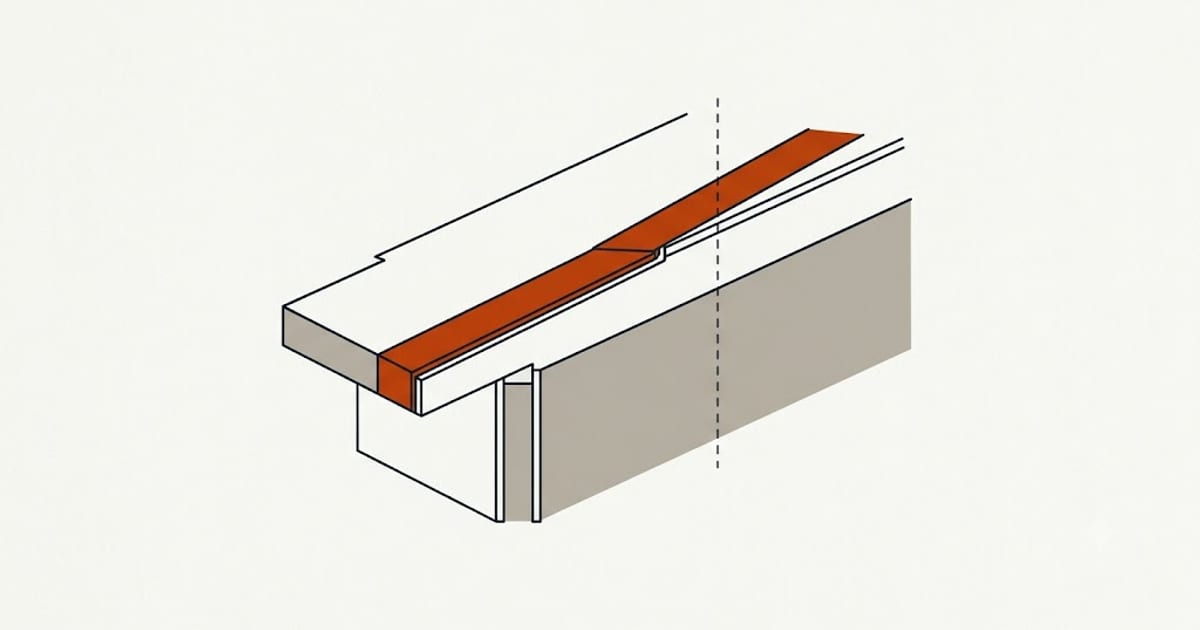
The IRC ice barrier rule (R905.1.2) is short and gets misread constantly:
In areas where there has been a history of ice forming along the eaves causing a backup of water, an ice barrier shall extend from the lowest edges of all roof surfaces to a point at least 24 inches inside the exterior wall line of the building.
Two things in that sentence do the work. Inside the exterior wall line, not from the roof edge. And measured along the slope, not horizontally.
What that means with an overhang
A house with a 24-inch overhang needs the membrane to run from the drip edge, up across the overhang, past the wall, and 24 inches further — a horizontal distance of 48 inches from the edge.
At a 6/12 pitch, 48 horizontal inches is 53.7 inches along the slope. A 36-inch-wide roll does not reach. That is two courses, lapped, on every eave.
| Overhang | Pitch | Slope distance from edge | Courses of 36″ membrane |
|---|---|---|---|
| 12″ | 4/12 | 38″ | 2 |
| 12″ | 8/12 | 43″ | 2 |
| 18″ | 6/12 | 47″ | 2 |
| 24″ | 6/12 | 54″ | 2 |
| 24″ | 10/12 | 62″ | 2 |
| 36″ | 6/12 | 67″ | 3 |
Almost every real roof needs two courses. Estimating one is the usual error, and it is discovered on the roof with the crew waiting.
Whether it applies to you
"A history of ice forming along the eaves" is decided by the local jurisdiction, not by the homeowner or the roofer. Most northern US municipalities adopt it outright; some southern ones do not require it at all.
Call the building department, or check the local amendments to the IRC. It is a two-minute question with a definite answer, and the inspector will be checking it.
Where to use it regardless of climate
Ice barrier costs several times what felt does per square, which is why it is used only where needed. These four places are worth it in any climate:
Valleys. Two roof planes funnel water into a valley at volume, and valleys are the second most common leak location on any roof. A full membrane course up the valley, before the field underlayment, is standard good practice everywhere.
Around chimneys, skylights and walls. Anywhere flashing meets the roof. The membrane self-seals around fasteners, which is exactly what is needed where step flashing is nailed.
Low-slope sections. Porch roofs and dormer tops at 2/12 to 4/12 move water slowly. If the doubled underlayment requirement applies, membrane is a better second layer than a second course of felt.
Rake edges on exposed sites. Wind-driven rain travels up a rake on an exposed hillside in a way it never does on a sheltered lot.
Two installation details that decide whether it works
It goes directly on the deck, under everything else. Field underlayment laps over its upper edge, and the drip edge at the eave goes under the membrane while the drip edge at the rake goes over the underlayment. That order is not arbitrary and getting it backwards funnels water into the fascia.
It is not removable. Self-adhering membrane bonds to the deck permanently. At the next tear-off it comes off with the plywood, or it does not come off at all. That is the accepted trade — but it means a deck with membrane on it will be replaced rather than reused at some point.
The line on the quote
Membrane is priced per roll, and a roll typically covers 1.5 to 2 squares at the required lap. Two courses along 80 linear feet of eave is roughly 3 to 4 rolls.
If a quote for a northern roof has no ice barrier line at all, it is either priced into the underlayment line or it is not there. Ask which — the same question applies to the doubled underlayment on shallow pitches, and both are invisible the day after the shingles go on.
The area it covers comes off the same measurements as everything else: eave length, overhang and pitch, which you already have if you have worked out the roof from the ground.