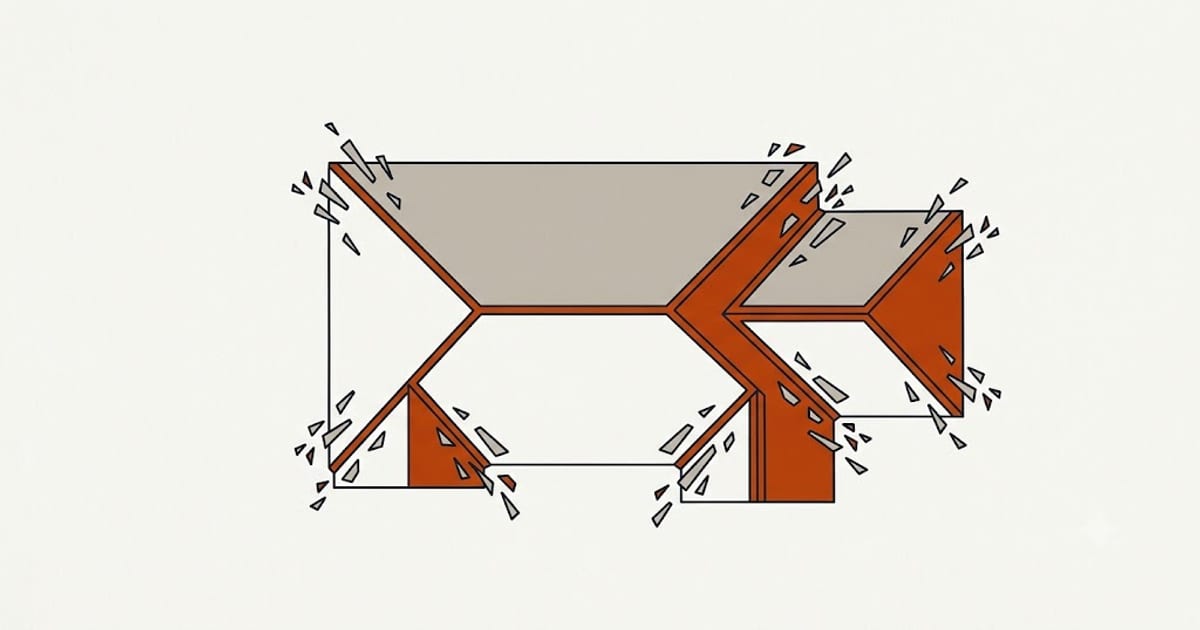
Waste factor is the percentage added to a shingle order to cover material that gets cut off and thrown away. It is not a contingency, not a fudge factor, and not a measure of how careful the crew is.
It is a geometric property of the roof, and you can predict it from a photograph.
Where waste physically comes from
Shingles arrive as rectangles. A roof plane that is itself a rectangle wastes almost nothing — the courses run edge to edge, and the only offcut is the tail end of each course, which starts the next one.
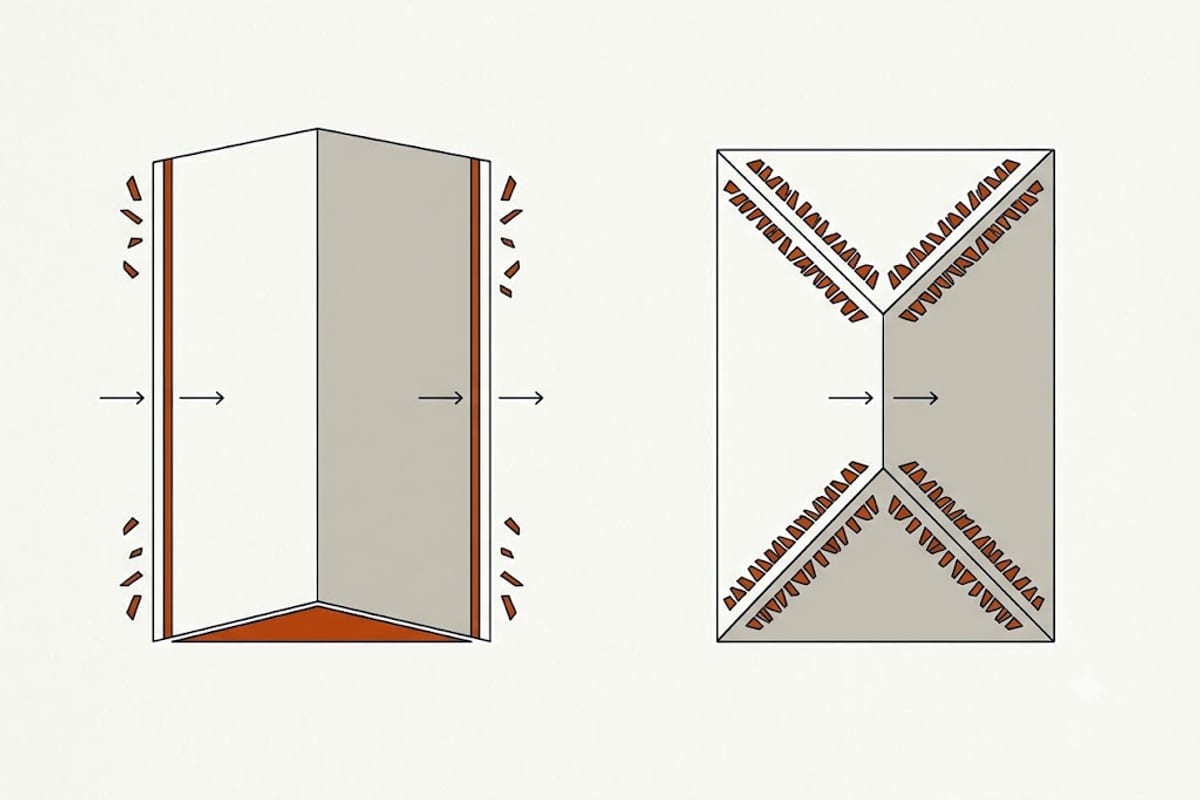
Waste appears wherever a course has to be cut at an angle:
- Valleys — every course on both planes is cut on the diagonal. This is the biggest source by a wide margin.
- Hips — same problem, on the upslope side.
- Rakes — a straight vertical cut, and the offcut is usable on the next course. Cheap waste.
- Dormers, chimneys, skylights — each one interrupts several courses and leaves fragments too short to use.
Notice what is not on that list: roof size. A 40-square simple gable and a 15-square simple gable have the same waste percentage, because the diagonal cut length scales with the roof, not with the number of squares.
The numbers by shape
| Roof shape | Waste factor | Why |
|---|---|---|
| Simple gable, no penetrations | 10% | Rake cuts only, mostly reusable |
| Gable with a few penetrations | 12% | Fragments around each interruption |
| Hip roof | 15% | Four diagonal cut lines |
| Cross-gable with valleys | 15–18% | Every valley cuts two planes |
| Cut-up: valleys, dormers, turrets | 20–25% | A fifth of the order is offcut |
| Steep roof, above 8/12 | +2–3% | Fewer usable drops, more breakage |
Below 10% is not achievable on any real roof. Above 25% and something else is going on — usually a shingle with a directional pattern, or a crew ordering a second colour run.
The mistake that makes waste look worse than it is
Waste is applied to the roof area, not to the bundle count after rounding.
A 24.6-square roof at 15% waste is 28.3 squares of material, which is 85 bundles. Round up to 85. Do not add waste, round to 25 squares, then add waste again — that double-count adds four bundles nobody needs, and it is common enough on estimates that it is worth checking.
Get the roof area right first with the squares calculation, then apply waste once.
Starter and ridge cap are not waste
They are separate products and they get ordered separately.
An estimate that says "add 15% for waste, that covers starter" is quietly planning to cut up field shingles for the starter course — which puts the sealant strip in the wrong place and voids the wind warranty on most brands. The waste line and the accessory line are two different lines.
What to do with the leftovers
Keep a bundle. Not for the aesthetics of matching — for the fact that granule colour drifts between production runs, so a repair in year eight with a fresh bundle is visible from the street, and a repair with a bundle from the original run is not.
One bundle in the garage is the cheapest insurance on the whole roof.
Working it out
For a roof you have already measured, the arithmetic is one multiplication: area × (1 + waste) ÷ 100 = squares, then × 3 = bundles for a standard architectural shingle.
Every size and pitch combination is already worked through — pick your roof and read it off rather than doing it by hand, and then check the total against what a roof of that size costs per square.
The one question that sets the number
Count the valleys from the ground. Zero valleys and a rectangular footprint is 10%. One or two valleys is 15%. More than two, or any dormer, is 20% and you should not let an estimator talk you down — the offcuts end up in the dumpster either way, and the only question is whether they were paid for in the first order or in a second delivery halfway through the job.