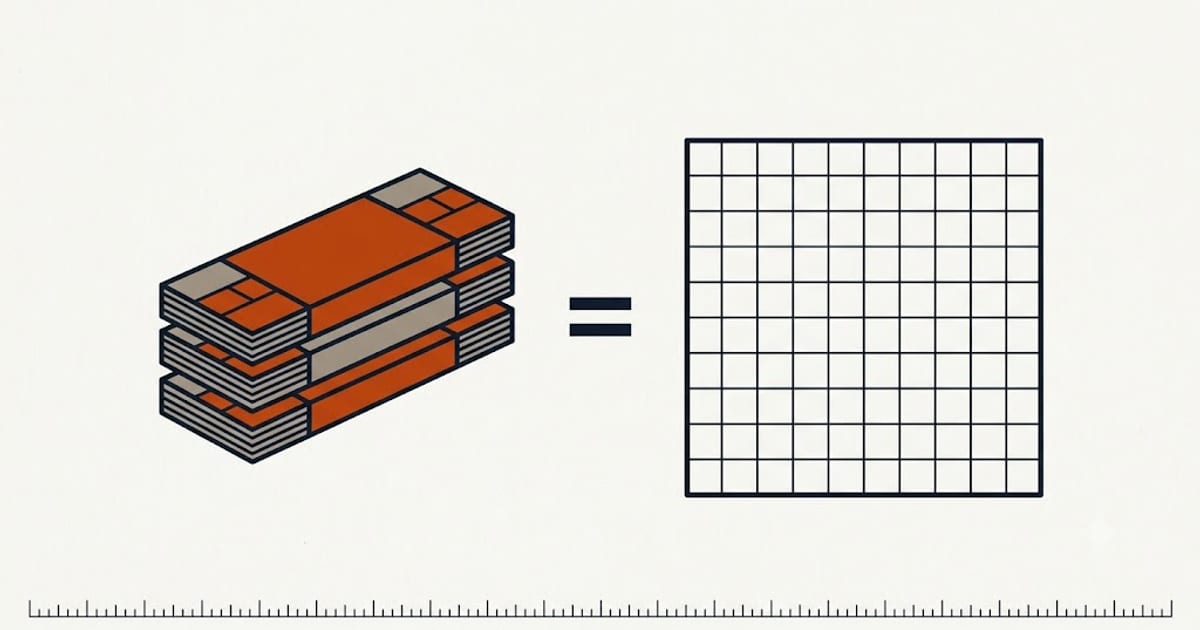
Three bundles per square covers standard three-tab and most architectural (laminate) shingles. That is the number to plan with, and it is right for the majority of what sits on a lumberyard rack.
It stops being right on premium lines, and the difference is expensive in both directions.
The exceptions, and why they exist
| Shingle type | Bundles per square | Reason |
|---|---|---|
| Three-tab | 3 | Thin, single layer |
| Architectural / laminate | 3 | Standard weight, two layers |
| Heavy architectural | 4 | Thicker laminate, fewer per bundle |
| Designer / luxury | 4–5 | Multiple laminate layers, much heavier |
| Impact-rated (Class 4) | 4 | Polymer-modified, thicker mat |
| Cedar shake look-alike | 5 | Deepest profile in the category |
The reason is weight, not area. A bundle has to be something one person can carry up a ladder — roughly 60 to 80 lb. A heavier shingle means fewer shingles per bundle, which means more bundles per square.
The coverage figure is printed on the bundle wrapper. It is the only source that is right for the product actually in front of you, and it takes ten seconds to read.
The counts that follow
For a 20-square roof:
- Standard architectural: 60 bundles, around 3,000–4,200 lb
- Heavy architectural: 80 bundles, around 4,800–5,600 lb
- Designer: 100 bundles, around 6,000–7,500 lb
That last row is three and a half tons on a roof. It matters for delivery — rooftop delivery by boom truck is worth paying for above about 25 squares, and some framing needs checking before a designer shingle goes on a house built for three-tab.
Exposure is what actually decides coverage
A shingle covers less than it measures, because each course overlaps the one below. Standard three-tab and architectural shingles run a 5⅝ inch exposure on a 36-inch-wide shingle, and the coverage figure on the wrapper already accounts for it.
Where this bites is on a low-slope roof. Between 2/12 and 4/12 the IRC requires doubled underlayment, and some manufacturers additionally specify a reduced exposure — which increases the number of bundles beyond the wrapper figure. Read the installation instructions for the specific product, not the general rule.
Starter and cap are not in this count
Neither is included in the field shingle figure, and both are separate SKUs:
- Starter strip: covers around 100–120 linear feet per bundle. You need it along every eave and every rake.
- Hip and ridge cap: covers around 20–35 linear feet per bundle depending on profile. You need it along the ridge and down every hip.
On a simple gable those two lines are small. On a hip roof with four hips and a ridge, cap alone can be six or seven bundles.
Buying by the bundle versus by the square
Yards price both ways and the per-square price is usually a little lower. It also arrives on a pallet, which is the right way to receive anything over about 15 squares.
Below that, bundles are easier to handle and easier to return, and measuring the roof from the ground is accurate enough to decide which way to buy. Most yards take back full, dry, unopened bundles; none of them take back a bundle that spent a week in the rain, because wet asphalt shingles stick to each other permanently.
Order in whole squares, then add
Work out squares including the pitch factor and waste — the size and pitch combinations are all worked out — then multiply by the bundle figure on the wrapper of the product you have actually chosen.
Doing it in the other order, bundles first and product second, is how a roof ends up with two brands of shingle on it.